|
The House Alarm system is the basis for the other alarm system, including the Calculator Alarm. It's powered by an integrated UPS (Uninterruptible Power Supply) connected to a standard AC power line. The battery system keeps the alarm module powered four weeks, with full monitoring during battery operation. The alarm module (the brains of the whole operation) contains 64MB of memory for logging, with a custom programming parameter memory area. The optional infrared interface will connect to a laptop or PDA in a 'console' mode (fully secured with encrypted user-defined passwords). All data to external (wired or wireless) control and/or status panels is 128-bit encrypted, using a "key" code unique to each alarm system. The alarm programming is also stored in nonvolatile RAM automatically, so even a full battery drain-down will not kill the alarm programming. The alarm panel interface is a standard looking alarm panel, with a digital display (three line LCD, 25 characters per line), numeric entry pad, and status lights. The three-line LCD display shows prompts and data entry values. All data entry, and current settings, can be printed out to the display or the optional thermal printing module. In addition to the "arm/disarm" codes, the alarm module responds to a special (user-defined) code sequence to enter a programming mode. In this mode, you can:
The product has various options (detailed below) such as a thermal tape printer about the same size that you would see on a small printing calculator. There are also connectors for extra hardwired alarm status/control panels, and the optional wireless status/control panel. The licensing agreement I have from the "national alarm systems company" does not allow me to disclose their name and some of the more technical details or product pictures. (Even though I don't suppose they are still in business after the "Digital Choke".) The optional items include (of course, mine has all the options):
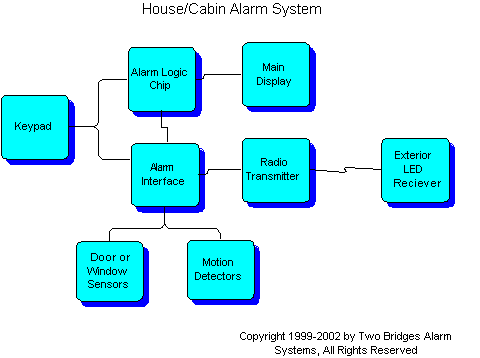
Of course, the alarms at the cabin and the hose connect to my own private alarm monitoring system, stored on one of my web servers, and mirrored to hidden areas (encrypted, of course) on several other systems I control. Alarm events are sent to my digital phone as text messages (with coded text, rather than plain text). The alarms are dialed out on one of the mirror servers, randomly selected, since each mirrored alarm "server" will randomly pass control to another system after a period of time. This ensures that my alarms are always monitored, but hard to trace. And my digital cell phone is registered to one of my 'dummy' corporations, to further reduce the threat of tracking. Even the cell phone cloaks the GIS signal, so you can't trace where the phone is (and where I am). And, for those that are curious, I have turned off the phone now that the Digital Choke has occurred, for reasons you'll find out in the story. But, I digress. Here's a block diagram of the Cabin Alarm, for those that might be interested. |
| House Alarm | Calculator Alarm | Cabin Floor Plan |